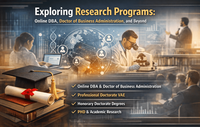
Research programs play a decisive role in advancing knowledge, innovation, and leadership across academic and professional domains. In an era where expertise is highly valued and specialization defines success, research-based qualifications have become a powerful tool for career growth and intellectual contribution. From academic pursuits like the PhD to professional pathways such as the online DBA, Doctor of Business Administration, professional doctorate VAE, and even the Honorary Doctorate, research programs cater to diverse ambitions and professional stages.
This article explores the evolving landscape of research programs, their significance, and how individuals can choose the right path to align with their goals.
The Meaning and Purpose of Research Programs
At their core, research programs are designed to foster advanced inquiry, critical thinking, and original contribution to a specific field of study. Unlike conventional degree programs that focus primarily on knowledge acquisition, research programs emphasize knowledge creation. Participants are expected to identify problems, develop frameworks, apply methodologies, and produce insights that have academic, professional, or societal relevance.
Research programs serve multiple purposes. They prepare scholars for academic careers, equip professionals with advanced analytical skills, and recognize individuals who have made exceptional contributions to society or industry. As global challenges become more complex, the demand for highly qualified researchers and thought leaders continues to grow.
PhD: The Foundation of Academic Research Excellence
The PhD remains the most recognized and rigorous research qualification worldwide. It is traditionally associated with universities and research institutions and is aimed at individuals who seek to contribute original knowledge to their discipline.
A PhD program requires deep engagement with theory, extensive literature review, and the application of robust research methodologies. The defining element of a PhD is the doctoral thesis, which presents original research findings that advance understanding within a specific field.
Graduates of PhD programs often pursue careers as university faculty, researchers, policy advisors, or specialists in knowledge-intensive industries. Beyond career outcomes, the PhD cultivates intellectual independence, discipline, and the ability to address complex problems systematically.
Doctor of Business Administration: Research with Real-World Impact
The Doctor of Business Administration is a research degree tailored for experienced professionals and business leaders. While academically rigorous, it differs from the PhD in its applied orientation. The focus is on solving real-world organizational and managerial challenges through research.
An online DBA has gained significant popularity in recent years, particularly among working professionals who require flexibility. These programs allow learners to balance professional responsibilities with advanced research studies, making doctoral education more accessible than ever.
The Doctor of Business Administration emphasizes strategic thinking, evidence-based decision-making, and leadership development. Research topics often address practical issues such as organizational performance, innovation management, sustainability, digital transformation, and global business strategy.
Online DBA Programs and Flexible Learning Models
The rise of the online DBA reflects a broader transformation in higher education. Digital platforms, virtual libraries, and remote supervision have enabled universities to offer high-quality research programs without geographical limitations.
Online DBA programs provide structured research training, regular academic guidance, and peer interaction through virtual seminars and discussions. These programs are particularly valuable for senior managers, entrepreneurs, and consultants who wish to apply research insights directly within their organizations.
By combining flexibility with academic rigor, online DBA programs bridge the gap between theory and practice, empowering professionals to become research-informed leaders.
Professional Doctorate VAE: Validating Experience Through Research
The professional doctorate VAE represents an innovative approach to doctoral education. VAE, or Validation of Acquired Experience, recognizes that knowledge is not gained solely through formal education but also through years of professional practice.
This pathway allows experienced professionals to earn a doctorate by demonstrating their expertise, achievements, and contributions through a structured research or reflective portfolio. The emphasis is on applied knowledge, professional impact, and analytical reflection rather than traditional coursework alone.
Professional doctorate VAE programs are particularly suited for individuals who have led complex projects, influenced organizational change, or contributed significantly to their industry. These programs validate professional experience at the highest academic level, offering recognition without requiring a conventional academic trajectory.
Honorary Doctorate: Celebrating Exceptional Contributions
An Honorary Doctorate is a prestigious recognition awarded by universities to individuals who have made outstanding contributions to society, culture, science, business, or public service. Unlike earned doctorates, honorary degrees do not require enrollment in a research program or completion of a thesis.
Honorary Doctorates symbolize respect, achievement, and societal impact. Recipients often include industry leaders, philanthropists, innovators, artists, and public figures whose work has created meaningful change.
While an Honorary Doctorate does not replace an academic qualification such as a PhD or DBA, it carries significant symbolic value and enhances professional credibility. It reflects a lifetime of dedication and influence beyond formal academic boundaries.
Comparing Academic and Professional Research Pathways
Research programs today are no longer limited to a single academic model. Traditional academic routes like the PhD coexist alongside professional doctorates, applied research degrees, and honorary recognitions. Each pathway serves a distinct purpose.
Academic research programs prioritize theoretical advancement and scholarly publication. Professional research programs focus on applied problem-solving and leadership development. Honorary recognitions celebrate impact rather than research output.
Understanding these distinctions helps individuals select a research pathway that aligns with their career stage, goals, and areas of influence.
Why Research Programs Matter in the Modern World
Research programs play a vital role in addressing global challenges such as economic inequality, technological disruption, healthcare innovation, and sustainability. Through structured inquiry and evidence-based analysis, researchers contribute solutions that shape policy, industry, and society.
For individuals, research programs offer numerous benefits. They enhance professional authority, open doors to senior leadership roles, and provide opportunities for lifelong learning. Research-trained professionals are often better equipped to navigate complexity, manage change, and drive innovation.
Whether pursued through a PhD, online DBA, or professional doctorate VAE, research education builds skills that remain relevant across industries and borders.
Future Trends in Research Programs
The future of research programs is marked by flexibility, interdisciplinarity, and global collaboration. Universities are increasingly adopting hybrid and online models to reach diverse learners. Interdisciplinary research is gaining prominence as complex problems demand integrated solutions.
Professional doctorates are expanding across fields beyond business, including healthcare, education, and technology. Recognition of prior learning and experience, as seen in VAE pathways, is reshaping how expertise is assessed and valued.
Honorary Doctorates continue to evolve as institutions seek to acknowledge contributions that extend beyond academia, reinforcing the connection between universities and society.
Conclusion
Research programs represent a powerful intersection of knowledge, leadership, and impact. From the academically intensive PhD to the practice-oriented Doctor of Business Administration, flexible online DBA, experience-based professional doctorate VAE, and prestigious Honorary Doctorate, each pathway offers a unique way to engage with research at the highest level.
Choosing the right research program depends on personal aspirations, professional background, and the type of contribution one wishes to make. As education continues to adapt to global needs, research programs remain central to innovation, credibility, and meaningful progress.
Embarking on a research journey is not merely about earning a title. It is about developing the insight, authority, and responsibility to shape the future through knowledge.