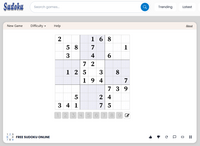
Sudoku is a popular number puzzle game that combines logical thinking, concentration, and problem-solving skills. Players around the world enjoy Sudoku because it offers a simple set of rules while providing endless opportunities to improve reasoning abilities. Whether you are a beginner learning the basics or an experienced player searching for a challenging puzzle, Sudoku delivers an enjoyable mental workout.
Unlike traditional mathematics exercises, Sudoku does not require advanced calculations. Instead, the game focuses on identifying patterns, recognizing possibilities, and placing numbers in the correct positions. Every completed puzzle brings a sense of achievement and encourages players to tackle more difficult challenges.
Sudoku is available in newspapers, puzzle books, websites, and mobile applications. Digital versions make the game especially convenient because players can enjoy puzzles at home, during breaks, or while traveling. With different difficulty levels and numerous puzzle variations, Sudoku remains an excellent choice for anyone who enjoys thoughtful entertainment.
The standard Sudoku puzzle uses a nine-by-nine grid divided into nine smaller three-by-three boxes. Some cells already contain numbers, while the remaining cells must be filled by the player.
The main objective is to complete the grid with numbers from one to nine. Each number must appear exactly once in every row, every column, and every three-by-three box. These rules create a logical structure that guides every decision.
Each horizontal row must contain the numbers one through nine without repetition. The same rule applies to every vertical column. Before entering a number, players should examine the corresponding row and column to determine which values are still available.
For example, if a row already contains the numbers one, two, four, six, and eight, the missing numbers are three, five, seven, and nine. The correct position for each missing number depends on the other numbers in the related columns and boxes.
Every small box introduces another important restriction. A number cannot appear twice inside the same box, even when the positions are located in different rows or columns.
Players should examine all three areas whenever they consider a possible placement. Checking the row, column, and box together reduces mistakes and helps reveal numbers that may otherwise remain difficult to identify.
Sudoku appeals to a wide audience because it combines accessibility with meaningful challenges. The basic rules are easy to understand, but solving advanced puzzles requires patience, careful observation, and systematic reasoning.
Sudoku encourages players to make decisions based on evidence rather than random guesses. Every number placed in the grid affects the remaining possibilities. By examining these relationships, players learn to eliminate incorrect options and identify valid solutions.
Regular practice also encourages a structured approach to difficult problems. Instead of feeling overwhelmed by an almost empty grid, players can divide the puzzle into smaller sections and solve one part at a time.
A Sudoku puzzle requires attention to several details simultaneously. Players must remember existing numbers, compare possible placements, and recognize patterns across the grid.
This process provides an opportunity to practice sustained concentration. Difficult puzzles also teach patience because some solutions become clear only after several other cells have been completed.
Many players enjoy Sudoku as a quiet activity that offers a break from everyday distractions. Focusing on a logical challenge can create an engaging routine without requiring expensive equipment or complicated preparation.
The game is also flexible. A quick puzzle may fit into a short break, while a more advanced challenge can provide entertainment for a longer period.
Although every puzzle presents different challenges, several techniques can make the solving process more efficient. Beginners should focus on reliable methods before attempting advanced strategies.
The first step is to scan the grid for rows, columns, and boxes containing many completed numbers. These areas usually have fewer missing values and provide useful starting points.
Players should identify which numbers are absent and compare the available positions. Filling cells with only one possible value creates a strong foundation for the rest of the puzzle.
The process of elimination is one of the most important Sudoku techniques. Instead of asking which number belongs in a cell immediately, consider which numbers cannot occupy that position.
If a cell is located in a row containing five and seven, a column containing two and eight, and a box containing one and four, those numbers can be eliminated from consideration. The remaining candidates become easier to evaluate.
When a cell has several possible values, writing down small candidate numbers can help organize the puzzle. This technique prevents players from repeatedly checking the same information.
As additional cells are completed, some candidates become impossible. Removing those options may eventually leave only one valid number.
A hidden single occurs when a particular number can occupy only one cell within a row, column, or box, even though that cell contains several possible candidates.
For example, three cells might appear suitable for different numbers, but only one of them may allow the number six. Recognizing this restriction can reveal a correct placement without requiring a guess.
Sudoku puzzles are commonly categorized as easy, medium, hard, and expert. Each level introduces a different degree of logical complexity.
Easy puzzles usually contain many starting numbers and several straightforward placements. They are ideal for learning the rules, practicing scanning techniques, and developing confidence.
Beginners should prioritize accuracy rather than speed. Understanding why each number belongs in a particular cell creates habits that remain useful when puzzles become harder.
Medium puzzles require more systematic elimination and candidate tracking. Players may need to compare several rows and boxes before finding a useful placement.
Hard puzzles often demand advanced logical techniques, including identifying pairs of candidates and recognizing relationships between different parts of the grid. These challenges reward careful analysis instead of hurried decisions.
Expert puzzles may contain fewer obvious opportunities and require multiple stages of deduction. Players often need to track candidate relationships across several rows, columns, and boxes.
Working through these puzzles can be demanding, but each successful deduction makes the remaining grid easier to understand. Consistent practice helps experienced players become more comfortable with complex patterns.
One frequent mistake is entering a number without checking all three restrictions. A value may fit the current row but conflict with the corresponding column or box.
Another common problem is relying on guesses too early. Guessing can create confusion when a later contradiction appears. Players should use logical elimination whenever possible and review their work when no clear move remains.
Ignoring candidate notes can also slow progress. Keeping possibilities organized makes it easier to recognize hidden singles, pairs, and other useful patterns.
Finally, rushing through a puzzle may cause simple errors that affect several later decisions. Taking a moment to verify each placement can save time and improve overall accuracy.
Online Sudoku provides a convenient way to enjoy puzzles without carrying printed books or newspapers. Many platforms offer multiple difficulty levels, helpful notes, mistake indicators, and optional hints.
Digital Sudoku also allows players to start a new challenge whenever they finish the current grid. Some versions include timers and daily puzzles for people who enjoy tracking progress or maintaining a regular routine.
Players should choose a difficulty that matches their current abilities while occasionally attempting more challenging grids. This balance keeps the experience enjoyable and encourages gradual improvement.
Sudoku is much more than a simple number game. It combines logical reasoning, concentration, patience, and pattern recognition in an accessible format that appeals to players of different ages and experience levels.
By understanding the basic rules, practicing effective strategies, and avoiding common mistakes, anyone can become more confident at solving Sudoku puzzles. Starting with easy grids and gradually progressing toward advanced challenges creates a practical path toward improvement.
Whether you prefer a quick mental exercise or a demanding expert puzzle, Sudoku offers a rewarding way to spend your free time. Open a new grid, examine the available numbers, and discover how every logical decision brings you closer to a complete solution.